Group Assignment 2: Feature Buffet
Overview
In this final implementation assignment, your team selects and implements 2-3 features from a provided menu. Unlike GA1, this assignment is graded primarily on process rather than product—demonstrating thoughtful design iteration, quality code review, and professional documentation matters more than feature completeness.
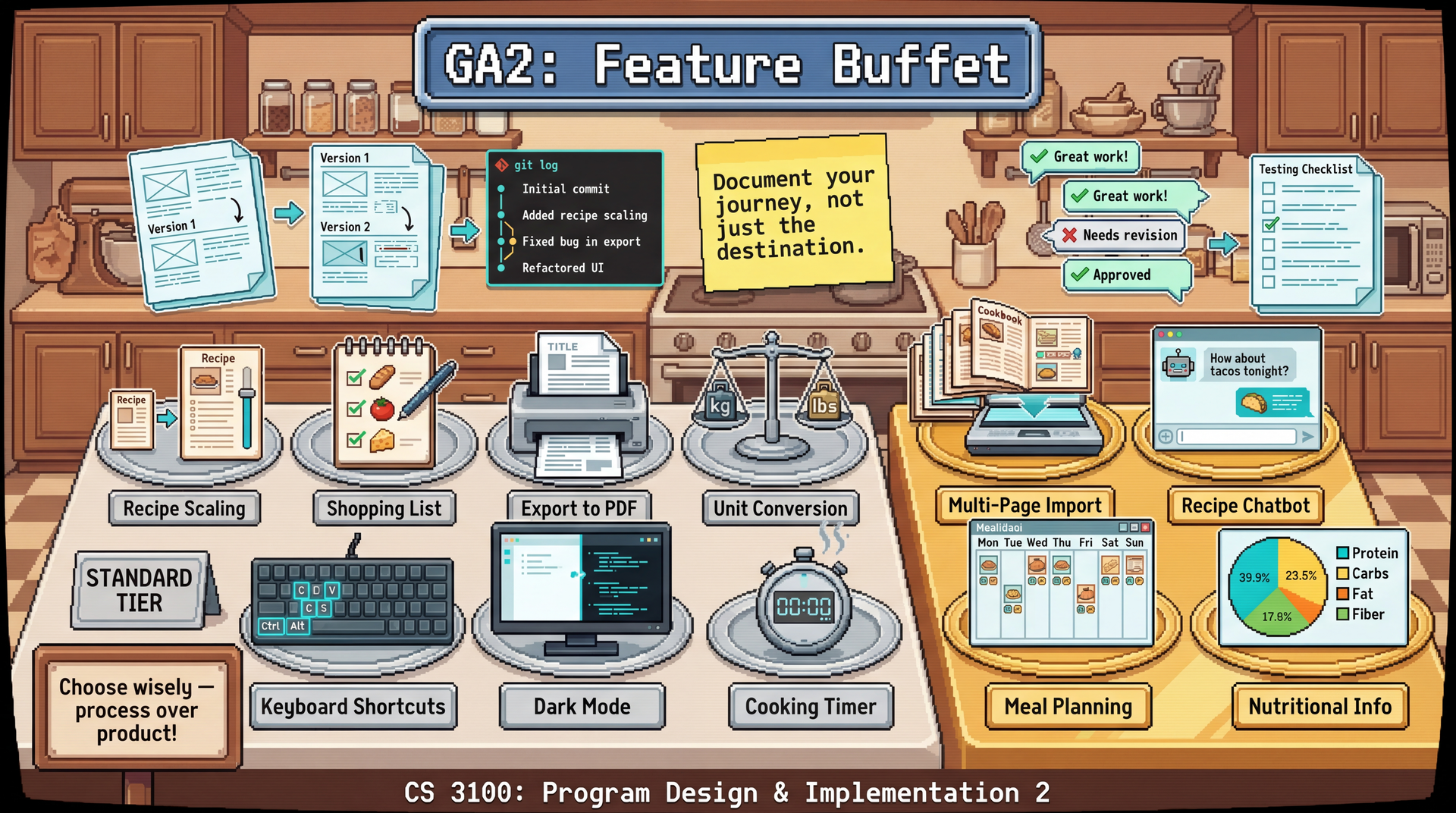
This approach reflects real-world software development: a well-documented, well-tested partial feature is more valuable than a hastily-implemented complete feature with no documentation or tests.
Due: Thursday, April 16, 2026 at 11:59 PM Boston Time
Prerequisites: GA1 (Core Features) must be complete. Your core features should be integrated and working. You will build on this foundation for your GA2 features.
Learning Outcomes
By completing this assignment, you will demonstrate proficiency in:
- Iterative design through documented design evolution (L27: User-Centered Design)
- Professional documentation of design decisions and implementation choices
- Quality code review that improves code and spreads knowledge (L22: Teams and Collaboration)
- Process reflection that identifies lessons learned and areas for improvement
AI Policy for This Assignment
AI tools are encouraged, but remember: we're grading process, not just product. AI can help you implement features quickly, but it cannot:
- Make design decisions for your specific users
- Document why you made the choices you made
- Provide meaningful code review (AI-generated review comments do not satisfy the code review rubric)
- Reflect on what you learned
Use AI as a tool, but ensure the thinking is yours. If you use AI assistance for implementation, you must be able to explain the code and design decisions in your own words during TA meetings.
The Feature Buffet
Choose 2-3 features from the buffet below. 3-person teams follow the same Feature Buffet process and grading as 4-person teams — the number of features selected and all process expectations are unchanged.
Standard Features
| Feature | Description | Complexity |
|---|---|---|
| Recipe Scaling | Adjust serving sizes with automatic ingredient recalculation | Medium |
| Shopping List | Generate aggregated shopping list from selected recipes | Medium |
| Export to PDF | Create nicely formatted PDF exports of recipes | Medium |
| Unit Conversion | Toggle between metric and imperial throughout the app | Medium |
| Keyboard Shortcuts | Comprehensive keyboard navigation and shortcuts | Medium |
| Dark Mode | Theme switcher with system preference detection | Low-Medium |
| Cooking Timer | Timers linked to recipe instruction steps | Medium-High |
| Cooking Mode | Step-by-step cooking interface: one instruction per screen with referenced ingredients, large easy-to-tap navigation buttons, and previous/next step controls | Medium |
Advanced Features
| Feature | Description | Complexity |
|---|---|---|
| Multi-Page Import | Import multiple files at once, multi-page PDF support, detect recipe continuation across pages | Medium-High |
| Recipe Chatbot | "What should I make?" meal suggestion assistant using Gemini API | Medium-High |
| Meal Planning | Calendar-based meal planning with recipe scheduling | High |
| Nutritional Info | API integration for nutritional data | High |
Process Portfolio
For each feature from the buffet, your team must submit a Process Portfolio demonstrating thoughtful development. This is the primary grading artifact.
1. Design Rationale (12% of feature grade)
Document (1/2 page):
- Why did you choose this feature?
- What user need does it address? (Reference a persona from GA0)
- What alternatives did you consider?
2. Design Artifacts (28% of feature grade)
Show your design evolution:
- Version 1: Initial wireframe/mockup
- Version 2+: At least one iteration with documented changes
- Rationale: Why did you change the design? What feedback prompted it?
Photos of whiteboard sketches are fine. The goal is showing iteration, not polish.
3. Implementation Journal (22% of feature grade)
Document your implementation process:
- Git history: Show incremental progress (not one giant commit at the end)
- PR history: Link to PRs with meaningful review comments
- Decision log: At least one documented technical decision with alternatives considered
4. Testing & Quality (25% of feature grade)
- Unit tests for the feature
- Brief accessibility check: Does it support keyboard navigation?
- Known limitations documented
5. Feature Summary (12% of feature grade)
- Screenshots: 2-3 screenshots showing the feature in action
- Integration notes: How does this feature connect to the rest of the app?
- Status: What's complete, what's in progress, what's known to be broken?
Your full demo video and project reflections are part of the Final Project Report, due April 20 — a few extra days after the GA2 implementation deadline to finalize these documentation tasks.
Grading Philosophy
A well-documented partial feature scores higher than a complete feature with no process evidence.
| Scenario | Score (out of 40) | Letter Grade Equivalent |
|---|---|---|
| Feature complete, excellent process documentation, meaningful iteration | 36–40 | A |
| Feature partially complete, excellent process documentation | 32–36 | B+ |
| Feature complete, minimal process documentation | 28–32 | B- |
| Feature generally broken, but excellent documentation of what was attempted | 28–32 | B- |
| Feature partially complete, minimal process documentation | 24–28 | C+ |
| Feature complete, no documentation | 20–24 | C- |
Grading Rubric
Total: 50 points — 40 points team (Process Portfolios) + 10 points individual (contribution evidence). This equates to 80% team / 20% individual grading.
Team: Process Portfolio (40 points)
Each feature is scored out of 40 points. If your team implements 2–3 features, scores are averaged to produce the 40-point team component. Components scored zero (entirely missing) will produce grades below the philosophy ranges above.
| Component | Points | Excellent | Satisfactory | Needs Improvement |
|---|---|---|---|---|
| Design Rationale | 5 | Clear user need, thoughtful alternatives considered | User need stated | Generic or missing rationale |
| Design Artifacts | 11 | 2 versions with clearly documented evolution | 2 versions shown | Single design, no iteration |
| Implementation Journal | 9 | Regular commits, quality PRs, decisions documented | Some commits, basic PRs | Large commits, no discussion |
| Testing & Quality | 10 | Comprehensive tests; known limitations documented | Basic tests present | Minimal or no testing |
| Feature Summary | 5 | Clear screenshots, integration well-explained, honest status assessment | Screenshots or status present | No summary provided |
| Total | 40 |
Individual Contribution (10 points)
Scored per team member based on evidence of personal engagement:
| Component | Points | Excellent | Satisfactory | Needs Improvement |
|---|---|---|---|---|
| Commit history & PR activity | 5 | Regular, meaningful commits; substantive PR participation | Some commits and PRs | Minimal commits; one large dump at the end |
| Code review quality | 5 | Substantive, specific review comments | Reviews present but surface-level | "LGTM" only or no reviews |
| Total | 10 |
Individual Accountability Adjustment
TA meeting observations and weekly collaboration surveys can adjust an individual's final grade by up to -20 points or award an upward adjustment of up to +20 points. If a team member cannot explain their code in TA meetings while the rest of the team succeeds, their grade may be reduced. The upward adjustment exists for a specific scenario: if your team's project isn't fully complete, but you went above and beyond to support struggling teammates — helping them get unblocked, taking on extra integration work, providing thorough code reviews — you can still earn full marks. This is not an extra credit mechanism; it is unlikely to bring a student above the assignment's total points. Simply doing your own work well is the expected baseline, not grounds for an upward adjustment. The weekly collaboration surveys (due Mar 23, Mar 30, Apr 6, Apr 13) inform this adjustment.
Submission
All deliverables should be merged to main following the Git Workflow for Team Projects. Your main branch is automatically submitted to Pawtograder.
Repository Contents
/menu-features/
  /feature-name-1/
    RATIONALE.md
    design/
      v1-wireframe.png
      v2-wireframe.png
      design-evolution.md
    IMPLEMENTATION_JOURNAL.md
    FEATURE_SUMMARY.md
  /feature-name-2/
    ...
Checklist
- 2-3 features selected from the buffet
- Process portfolio complete for each feature (including feature summary with screenshots)
- Weekly collaboration surveys up to date (due each Monday via Pawtograder)
Reflection Questions for Team Discussion
Before submitting, discuss as a team:
- Which feature had the smoothest development process? Why?
- Where did your GA0 design artifacts help most? Where did they fall short?
- What would you do differently if starting the group project over?
- What's one thing each team member learned from another team member?
These don't need to be submitted, but inform your individual reflections in the weekly team collaboration surveys and the final individual reflection.
As part of the Final Report, each team member must submit an individual reflection. This is a mandatory gate — your individual and team grades for the final report are not released until it is submitted. Keep notes throughout GA2 so you're prepared.