Lecture overview:
Total time: ~50 minutesPrerequisites: L17 (creation patterns, DI, service wiring), L16 (testability), L6-L7 (information hiding, coupling)Connects to: L19 (Architectural Qualities), L20 (Networks & Security), L36 (Sustainability) Structure:
Design vs. Architecture (~8 min)
Architectural Drivers (~10 min)
Finding Service Boundaries (~20 min)
Communicating Architecture: C4 & ADRs (~12 min)
Upfront vs. Piecemeal Growth (~10 min — if time)
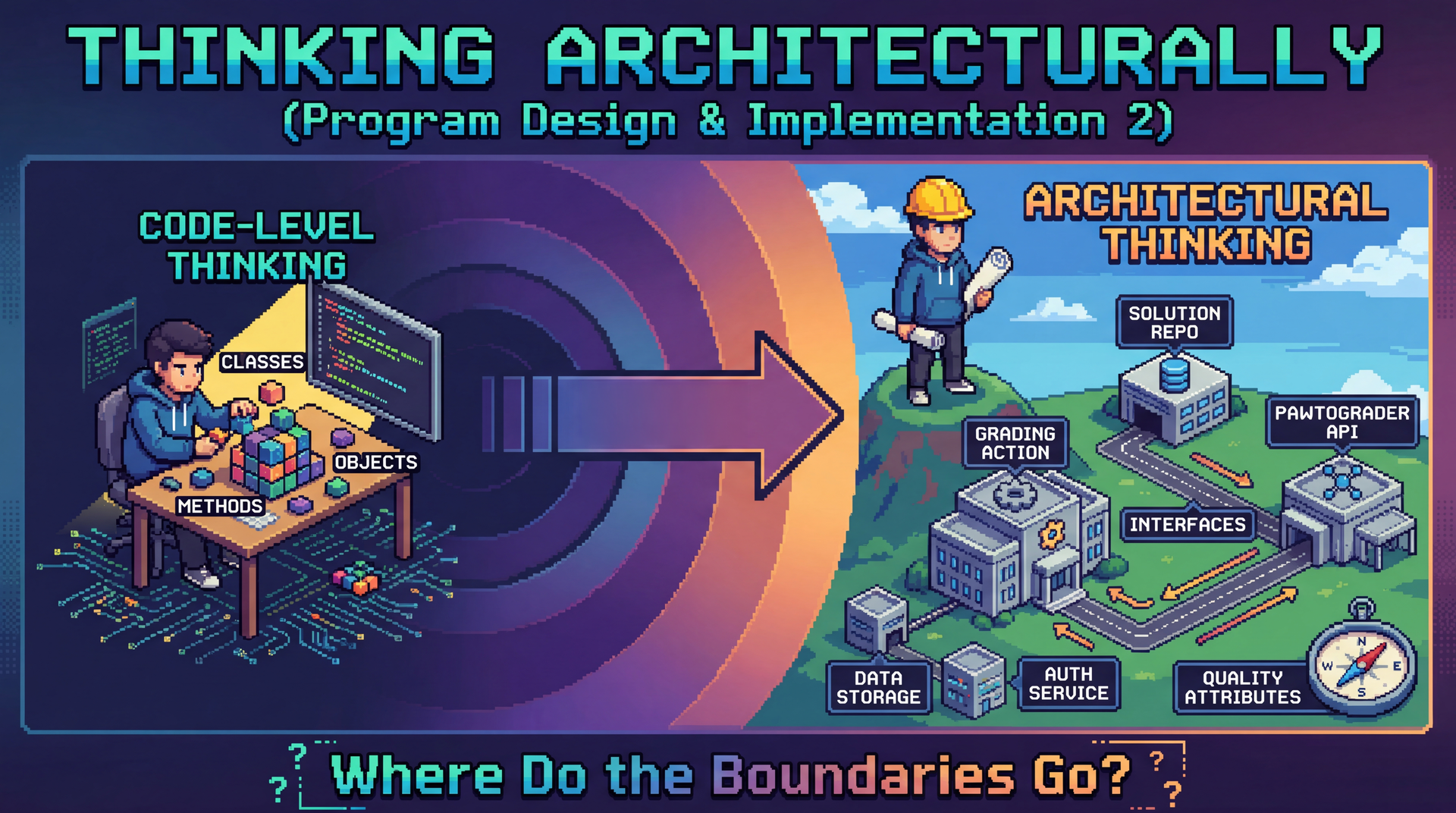
Key theme: We've been building objects and wiring them into services. Now we step back and ask: where do those service boundaries come from? We'll use Pawtograder's autograder — the system that grades YOUR assignments — as our running example.
→ Transition: Let's start with the title...
CS 3100: Program Design and Implementation II Lecture 18: Thinking Architecturally
©2026 Jonathan Bell & Ellen Spertus, CC-BY-SA
Context:
L17 ended with creation patterns and DI — how do we wire services together?
Today: how do we decide what those services should BE?
Running example: Pawtograder's autograder — the system they use every day
Key message: "Same principles you already know — information hiding, coupling, cohesion — but applied at a bigger scale."
→ Transition: Here's what you'll be able to do after today...
Learning Objectives
After this lecture, you will be able to:
Define software architecture and distinguish it from design Identify architectural drivers (functional requirements, quality attributes, constraints) that shape decisions Apply heuristics to determine service/module boundaries and design good interfaces Use the C4 model to communicate architecture at different levels of detail Write Architecture Decision Records (ADRs) to capture the why behind decisions Design vs. Architecture: A Continuum
Design and architecture exist on a continuum. They ask different questions at different scales.
Design — The Details
How is this class organized?
What data structures should we use?
How do these methods collaborate?
Which pattern fits this problem?
Architecture — The Big Picture
What are the major components?
How do they communicate?
What are the quality requirements?
Which decisions are hard to change later?
A useful heuristic: architectural decisions are the ones that are expensive to change .
Case Study: Microblogging Requirements
Before we compare two microblogging systems, let's think about what any microblogging platform needs to do:
👤 Identity — Create and authenticate user accounts
✏️ Publishing — Post short messages with mentions and hashtags
👥 Social graph — Follow other users
📰 Feed — Show relevant posts from followed users
🛡️ Moderation — Enforce community standards
🔔 Notifications — Alert users to replies and mentions
Discussion: What decisions would be "expensive to change"?
Where does user identity live? Who controls the feed algorithm? Who decides what content is allowed? What happens when millions of users post at once?
PAUSE FOR DISCUSSION (2-3 min):
Prompt students to think before revealing the answers:
"If we wanted to move user accounts from one server to another, how hard would that be?"
"What if we want communities to set their own moderation rules?"
"What if we want to change who controls what appears in a user's feed?"
Common student responses to watch for:
Identity: Some may say "just a database table" — push back: every post, follow, and mention links back to identity. Moving it touches everything.Moderation: Who enforces rules? A central team? Each community? This shapes the entire permission model.Feed algorithm: Centrally ranked vs. user-controlled — changing this after the fact means rethinking what data you even store. Key insight to plant:
"Your instincts about what's 'easy' or 'hard' to change — those instincts ARE architectural thinking. We're going to compare two systems that made very different choices about exactly these questions."
→ Transition: Let's see how two different systems answered these questions...
Architecture: Chirp vs. Flock
Two systems, same problem — different architectural choices:
Decision Chirp (centralized) Flock (federated) Where does identity live? Central server owns all accounts Each server owns its own users Where is content stored? Single platform database Distributed across servers Who controls the feed? Platform algorithm Each server (or user) Who moderates content? The platform Each server independently
Why these are architectural:
Identity: Every post, follow, and mention depends on it — changing it touches everythingContent storage: Determines what queries are even possible and who can run themModeration: Shapes the entire permission model and who has authority over whatMake this concrete:
"Think about what happens when you @mention someone. In Chirp, that's a lookup in one database. In Flock, that mention might need to reach a completely different server."
"Think about what happens when a server in Flock shuts down — those users and their posts are gone. That's a consequence of the identity decision."
These are design choices, not mistakes:
Chirp's centralization makes some things easy: consistent experience, powerful recommendations, fast search
Flock's federation makes other things possible: user autonomy, community self-governance, no single point of control
→ Transition: So what drives a system toward one of these architectures?
The Key Insight
Neither architecture is "wrong" — they reflect different requirements and different values .
Chirp (centralized) Flock (federated) Primary goal Consistent experience, powerful recommendations User autonomy, community self-governance Moderation Platform enforces global rules Each server sets its own rules Scalability Easier to optimize centrally Naturally distributed load User trust Trust the platform Trust your own server
This raises a question: What forces push a system toward a particular architecture?
What Drives Architectural Decisions?
Architecture doesn't happen in a vacuum. Decisions are shaped by architectural drivers :
Three categories of forces:
Functional requirements: What the system must doQuality attributes: How well it must do it (the "-ilities")Constraints: Fixed boundaries we can't change Key insight:
Functional requirements tell you WHAT capabilities exist
But they don't dictate HOW to structure them
Quality attributes and constraints shape the structure
→ Transition: Let's look at each driver for Chirp and Flock...
Driver 1: Functional Requirements
What must any microblogging platform do?
Create and authenticate user accounts Post short messages, with support for mentions and hashtags Follow other users and see their posts in a feed Moderate content that violates community standards Notify users of replies, mentions, and follows
A single monolithic application COULD do all of this. But should it? The functional requirements alone don't tell us how to structure it — or whether identity should be centralized or federated.
Driver 2: Quality Attributes (the "-ilities")
Both Chirp and Flock must address the same quality attributes — but their architectures lead to very different tradeoffs.
You already know these:
Changeability (L6-L7): Chirp must update globally to comply with new regulations. A Flock server operator can adapt independently.Testability (L16): Chirp's services can be tested in isolation. Flock's federated interactions require simulating multiple servers. Same principles from class design — now at service scale!
Coming up:
Security (L20): Keep real user identities secret — one central target vs. distributed exposureScalability (L21): Millions of posts per day — central infrastructure vs. distributed loadDeployability (L36): Chirp pushes updates instantly; Flock servers update independentlyMaintainability (L36): Well-funded corporation vs. mostly volunteer server operators
Quality attributes often conflict . Flock's distribution improves autonomy but hurts consistency. Architecture = making these tradeoffs consciously.
Connect to prior knowledge:
"You already know how to design for change at the class level — information hiding, low coupling, high cohesion"
"You already know testability — observability, controllability, separating 'what to do' from 'how to connect'"
"Today we're applying those SAME principles at a bigger scale"
Chirp vs. Flock tradeoffs to highlight:
Changeability: Chirp can enforce a regulation change globally overnight; a Flock server in another jurisdiction can simply not comply — or adapt faster
Testability: Testing a Chirp service is straightforward — mock its dependencies. Testing Flock federation means you need two servers talking to each other, which is much harder to set up in a test environment
Maintainability: Chirp has engineers on call 24/7; a Flock server might be run by one volunteer who goes on vacation
Preview future lectures:
L20: How do we authenticate across servers? How do we keep identities secure? (Security)
L21: How does each architecture handle millions of concurrent posts? (Scalability)
L36: How do we deploy changes safely across a federated network? (Deployability, Maintainability)
→ Transition: Constraints also shape what's possible...
Driver 3: Constraints
Constraints are non-negotiable boundaries. They limit our design space:
Source Chirp Flock Platform Large data centers, owned infrastructure Distributed volunteer-run servers Legal Must comply with laws in every jurisdiction globally Each server complies with its own local laws Identity Must authenticate millions of users centrally Must federate identity across independent servers Moderation Must enforce a single global content policy Each server enforces its own rules
Constraints aren't negotiable the way quality attributes are. They're the fixed boundaries within which we architect. Sometimes constraints ARE the architecture — Flock's requirement that no single entity owns the network dictates its entire structure.
Constraints vs. quality attributes:
Quality attributes are things we WANT (security, scalability)
Constraints are things we MUST accept (data center limits, legal jurisdiction, volunteer infrastructure)
Together they shape WHAT architectures are even possible
The Flock point is worth dwelling on:
The decision that no single entity should control the network isn't just a preference — it's a founding constraint
Once you accept that constraint, federation follows almost automatically
The architecture IS the constraint made concrete
Chirp's legal constraint is also interesting:
A centralized platform is legally responsible for ALL content globally
This creates pressure toward aggressive moderation and content policies
Flock sidesteps this by distributing legal responsibility to individual server operators
→ Transition: Now that we know the drivers, how do we find the right boundaries?
Drivers Tell Us What; Heuristics Help Us Find Where
We know we need changeability, testability, scalability. But where do we actually draw the lines?
Rate of Change — Things that change at different speeds should be separate
Actor — Things owned by different people should be separate
Interface Segregation — Clients that need different things should get different interfaces
Testability — Things that need independent testing should be separable
Bridge from drivers to heuristics:
We just identified WHAT we care about: functional requirements, quality attributes, constraints
But knowing we need "changeability" or "testability" doesn't tell us WHERE to draw the lines
These four heuristics are lenses for examining a system to find natural boundaries
How they connect to drivers:
Changeability driver → Rate of Change heuristic helps us isolate fast-changing parts
Maintainability driver → Actor heuristic helps us give each team a clear slice
Testability driver → Testability heuristic helps us design components that can be tested alone
Coming up:
We'll apply each heuristic to Chirp and Flock and see how the same boundaries emerge from multiple angles — that's a sign we've found a natural seam.
→ Transition: Let's start with rate of change...
Heuristic 1: Group by Rate of Change
Things that change at different rates should live in different components:
Component How Often It Changes Who Changes It A user's posts and follows Continuously — every interaction The user Feed ranking algorithm Every few weeks Platform engineers Identity & authentication Rarely — breaking change Security team The post data format Very rarely — affects everything Architects (carefully!)
✓ User data changes constantly → it SHOULD be separate from the feed algorithm that changes monthly. And both should be separate from identity that almost never changes.
Four things, four rates of change:
User posts and follows — change with every interaction, continuously
Feed algorithm — tweaked regularly to improve recommendations or address abuse
Identity and authentication — very stable; changing this is a major undertaking
Post data format — the contract everything depends on; changes almost NEVER
The data format is the most stable:
If the structure of a post changes, every component that reads or writes posts must change together
That's why it changes "very rarely" — it's the stable contract that lets other pieces evolve independently
Chirp vs. Flock difference:
In Chirp, all of these live on the same platform — but they should still be separate services internally
In Flock, rate of change also determines what must be standardized across servers (the post format) vs. what each server controls independently (the feed algorithm)
→ Transition: Different people care about different parts...
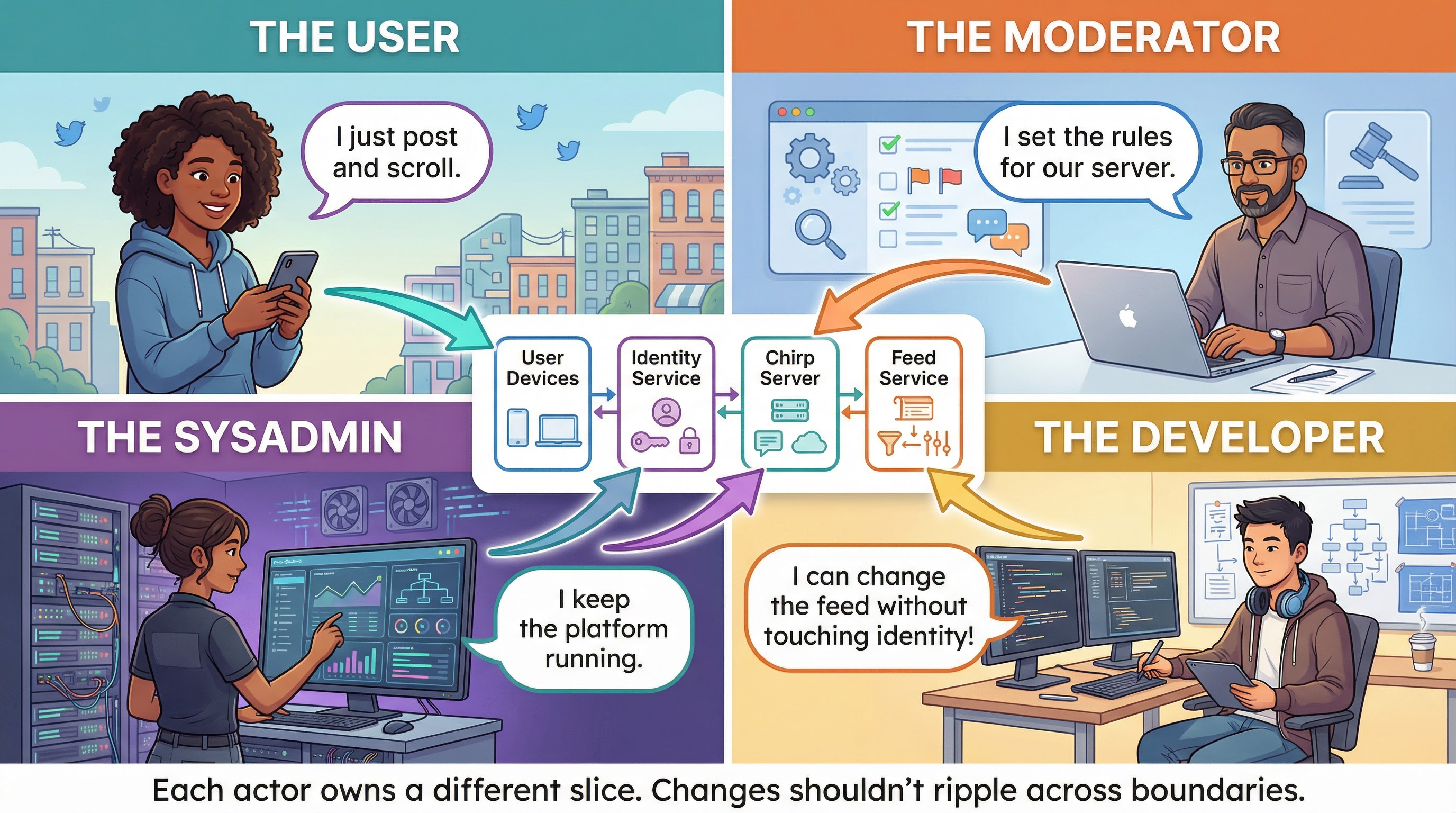
Heuristic 2: Each Actor Gets Their Own Slice Walk through the graphic — four actors, four slices:
User: Posts messages, scrolls their feed — never touches server configCommunity Moderator: Sets moderation rules for their server — never modifies feed algorithm codeSysadmin: Maintains platform infrastructure — doesn't write moderation policiesDeveloper: Can improve the feed algorithm without touching identity or moderation Key insight: changes from one actor shouldn't ripple to another's code.
When a moderator updates rules → feed algorithm and identity unchanged
When a developer tweaks the algorithm → moderation policies unchanged
When a sysadmin updates infrastructure → users see no difference
Connection to L8 (SOLID): This is Single Responsibility Principle at architectural scale — each component has one reason to change, corresponding to one actor.
Chirp vs. Flock:
In Chirp, the sysadmin and developer are the same company — but the slice separation still matters
In Flock, the community moderator is often a completely different person from the sysadmin — the architecture must enforce this separation
→ Transition: What if we forced all clients to use one fat interface?
Heuristic 3: Apply Interface Segregation
Don't force clients to depend on interfaces they don't use. What if we had one fat interface?
public interface MicrobloggingSystem { void post ( String userId , String message ) ; List < Post > getFeed ( String userId ) ; void removePost ( String moderatorId , String postId ) ; void banUser ( String moderatorId , String userId ) ; List < Post > getFlaggedPosts ( String serverId ) ; void receivePost ( String originServer , Post post ) ; void syncFollows ( String originServer , List < Follow > follows ) ; String getPublicKey ( String serverId ) ; }
A regular user shouldn't need to know about federation keys. A remote server syncing posts shouldn't need to know about moderation. We'll design the better version after finishing the heuristics.
What's wrong with this?
Users only care about posting and reading — they don't need syncFollows or getPublicKey
Remote servers syncing content don't need banUser
Moderators don't need federation methods
Coupling everything together means changing ANY part risks breaking ALL parts
Don't solve it yet! We'll design the better, segregated interfaces after we finish all four heuristics. For now, plant the seed that ISP applies at the service level too.
→ Transition: One more heuristic — testability...
Heuristic 4: Optimize for Testability
Can you test a component without deploying the whole system?
Component Testable in Isolation? How? Feed algorithm ✅ Yes Pass a list of posts and follows, check ranked output — no network needed Post validation ✅ Yes Check character limits, banned words, media types — pure logic Identity & auth ✅ Yes Test token generation and verification independently Federation (Flock) ⚠️ Hard Requires two servers talking to each other — integration test
Chirp's services can be tested independently with mocks. Flock's federation is an architectural boundary that's genuinely harder to test — simulating two servers is more complex than simulating a function call. That's a real tradeoff.
Connection to L16 (Testability):
Same principle: separate "what to do" from "how to connect"
The feed algorithm doesn't need a real database to test ranking logic
Identity doesn't need a real network to test token verification
The Flock federation point is important:
This is a case where the architectural choice (federation) makes one quality attribute (autonomy) better and another (testability) harder
That's not a mistake — it's a conscious tradeoff
Architecture = making tradeoffs consciously
→ Transition: Putting the four heuristics together...
Emerging Architecture: Three Components
Applying our four heuristics, a natural structure emerges for both systems:
A Design Decision: Where Does the Feed Algorithm Live?
We need to rank posts for each user's feed. Where should that logic live?
Option A: Algorithm in the Platform (Chirp)
The platform ranks all feeds centrally using global signals (engagement, recency, relationships).
Pros: Powerful recommendations, consistent experience, easy to improve globallyCons: Platform controls what users see; hard to customize per community Option B: Algorithm per Server (Flock)
Each server ranks feeds independently. Users may even choose their own algorithm.
Pros: Community autonomy, no single point of controlCons: No global signals; harder to build powerful recommendations; inconsistent experience
Neither is wrong — Chirp optimizes for recommendation quality, Flock optimizes for autonomy. But this decision is expensive to change : switching from centralized to federated ranking would require rearchitecting how posts are stored and shared across the entire network.
Why is this expensive to change?
Centralized ranking requires all posts to flow through one place — the database schema, the storage model, and the delivery pipeline all assume this
Switching to federated ranking means posts must be stored and indexed on each server — every component that touches posts must change
Six months in, if you try to extract ranking into per-server logic, it's intertwined with storage, with the UI, with notification delivery...
"Should I throw it away and start over?" — that's the definition of an expensive decision
Connection to Pawtograder equivalent:
This is the same kind of decision as "where does language logic live?"
In both cases: normalizing early (in the action / in the platform) keeps the downstream component simple
But it concentrates power in the component that does the normalizing
→ Transition: So we've found our boundaries. How do we design the interfaces between them?
Interface Design at the Service Level
Once we've identified components, we need to design their interfaces. The same principles from class design apply—and so do the same patterns from L17.
Dependency Injection at service scale:
public class FeedService { private final IdentityService identityService ; private final PostRepository postRepository ; public FeedService ( IdentityService identityService , PostRepository postRepository ) { this . identityService = identityService ; this . postRepository = postRepository ; } } Strategy Pattern for Extensibility
Use the Strategy pattern to make the feed algorithm swappable without changing FeedService:
The Strategy pattern for extensibility:
Adding a new ranking algorithm = new RankingStrategy class, nothing else changes
Chirp might use EngagementStrategy by default; a Flock server might prefer ChronologicalStrategy
CommunityStrategy could let server operators tune ranking for their community
Connection to DI:
The RankingStrategy is injected into FeedService — same principle as the previous slide
DI handles outward dependencies; Strategy handles internal variation
→ Transition: What do these contracts actually look like?
The Contracts: Data Types That Cross Boundaries
The interface isn't just method signatures — it's the data types that flow across. These are the contracts that must remain stable:
public record Post ( String postId , String authorId , String content , Instant createdAt , String originServer ) { } public record FeedResponse ( List < Post > posts , String nextPageToken , Instant generatedAt ) { } public record FederatedPost ( Post post , String signature , String publicKeyUrl ) { }
If Post were poorly designed — no originServer, no stable authorId — Flock's federation would be impossible to add later. This contract deserves careful design.
Why these contracts matter:
Post is the data type that crosses every boundary — feed service reads it, identity service writes it, federation sends it
If Post changes shape, every component changes with it
That's why it's in the "very rarely changes" row of our rate-of-change table
The FederatedPost type:
This only matters for Flock — Chirp doesn't need cryptographic signatures
But designing Post to include originServer from the start means Chirp could add federation later without changing the core data type
That's designing for changeability at the data layer
Connect back to the heuristics:
Rate of change: Post changes rarely — it's the stable contract
ISP: FeedResponse is for clients; FederatedPost is for servers — different clients, different types
Testability: You can test the feed service by constructing Post objects directly — no database needed
→ Transition: How do we communicate this architecture to others?
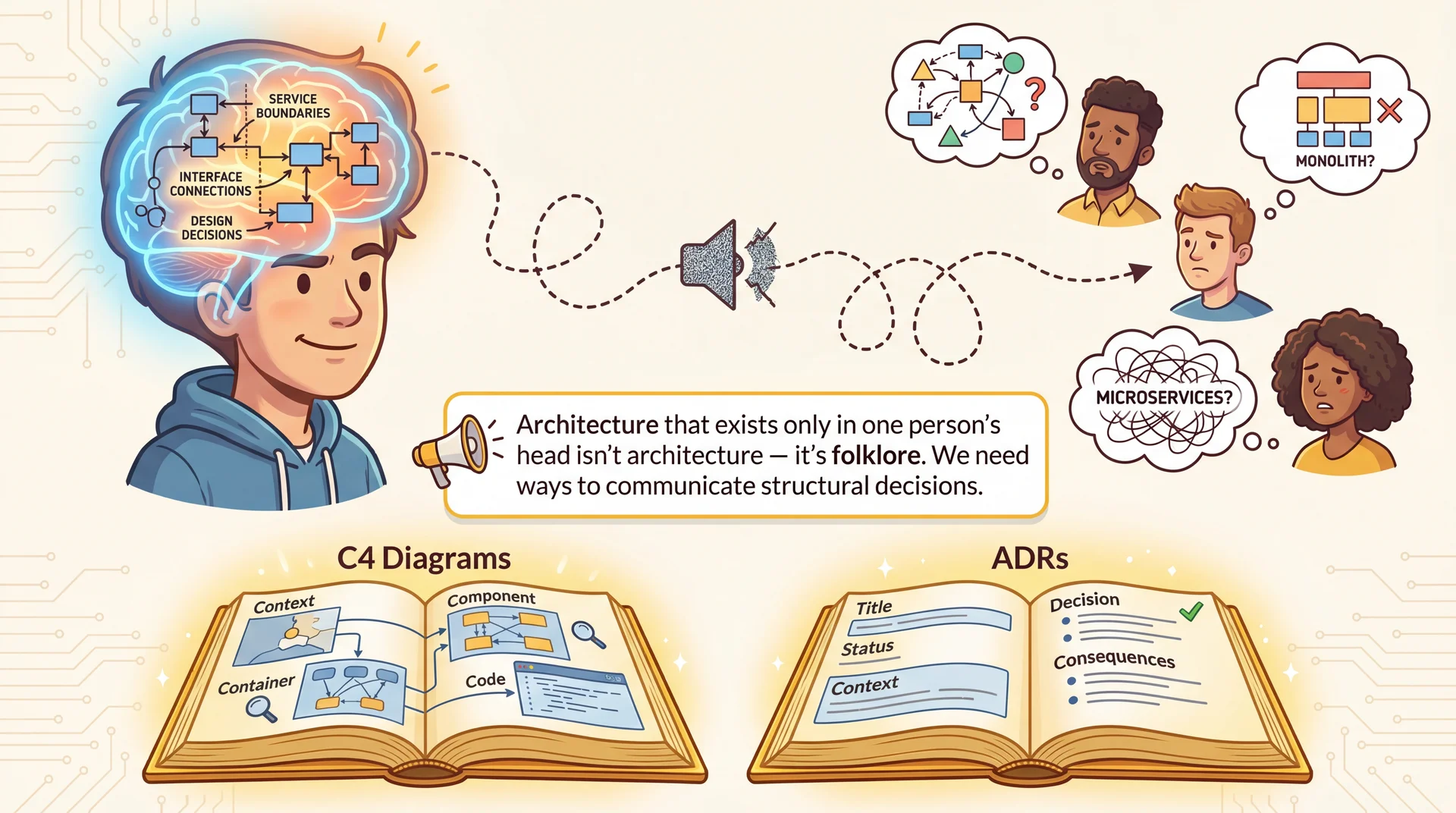
Architecture in Your Head Is Folklore The communication challenge:
We just covered: three components, four heuristics, data coupling decisions, interface contracts, record types...
How would you explain all of that to a new team member?
How would you explain it to a community moderator who just wants to set rules for their server?
How would you explain it to a sysadmin who needs to debug the platform?
The problem:
If this architecture only exists in one person's head, it degrades like a game of telephone
Six months later, everyone has a DIFFERENT mental model
New contributors make changes that violate boundaries they didn't know existed
"Why doesn't the feed service just query identity directly?" — because they never saw the ADR
Structured approaches help:
C4 Diagrams — Show the system at different zoom levels (different audiences need different detail)ADRs — Capture WHY we made decisions, not just WHAT we built → Transition: Let's look at C4 first — four levels of zoom...
The C4 Model: Four Levels of Zoom Level Shows Chirp/Flock Example 1. System Context System + Users + External User ↔ Device ↔ Microblogging System ↔ Moderator 2. Container Deployable Units Feed Service , Identity Service , Platform API , Database 3. Component Internals of one Container Inside Feed Service: PostRepository, RankingStrategy, FeedController 4. Code Classes / Interfaces RankingStrategy interface, Post record
Let's walk through all four levels for Chirp, so you can see how each level zooms in on a different scale of the same system.
The C4 model , created by Simon Brown, provides four levels of abstraction for architectural diagrams.
Key insight: You don't always need all four levels. Use the level that answers the question your audience is asking.
→ Transition: Let's start at the widest zoom level...
C4 Level 1: System Context
Who uses the system, and what external systems does it talk to? This is the "napkin sketch" level.
At this level, the entire platform is a single box. We don't care what's inside — only what it interacts with.
The "elevator pitch" diagram:
A non-technical stakeholder could read this and understand the system's role
No internal details — just actors and external systems
Chirp vs. Flock at Level 1:
Chirp's Level 1 looks like this — one central system
Flock's Level 1 would show MULTIPLE microblogging systems talking to each other via federation
That difference at Level 1 already tells you something fundamental about the architecture
→ Transition: Zoom in to see the deployable units...
C4 Level 2: Container
Zoom into the "Microblogging System" box. What are the major deployable units?
The narrow API boundary between the Feed Service and Platform API is deliberate — the feed service never touches the database directly.
What this reveals:
The three components we identified earlier, plus the database
Communication mechanism: HTTPS + JSON through well-defined endpoints
Rate of change is visible: feed service changes fast, identity and API change slowly
Flock's Level 2 would look different:
Each server is its own container
A federation layer appears between servers
The database is local to each server, not shared
→ Transition: Zoom into the Feed Service...
C4 Level 3: Component (Feed Service)
This view shows how FeedController orchestrates the internal components. RankingStrategy is the extension point — swapping algorithms doesn't touch anything else.
C4 Level 4: Code (RankingStrategy)
Zoom into the RankingStrategy extension point. What are the actual classes and interfaces?
Level 4 shows actual code structure. You'd rarely draw this for the whole system — it's useful for specific extension points or critical interfaces.
When to use Level 4:
Documenting extension points (like RankingStrategy)
Critical interfaces where getting the design right matters (like Post)
NOT for the entire system — too much detail
The connection back to Arc 3:
We designed this interface earlier when discussing the Strategy pattern
Level 4 is where architecture and design meet — the interface is an architectural decision, the implementations are design decisions
→ Transition: Choosing the right level for your audience...
Choosing the Right Level
Use the right level of detail for your audience:
Audience Useful Levels Why Non-technical stakeholders Level 1 Need to understand what the system does, not how Community moderators Levels 1–2 Need to see where moderation rules fit in the system Platform engineers Levels 2–3 Need to understand component responsibilities and dependencies Contributors adding a ranking algorithm Levels 3–4 Need to see the extension point and its interface
Key insight: Match the diagram to the audience. Don't show Level 4 code diagrams to non-technical stakeholders.
Flock note:
A Flock server operator needs a Level 1 diagram showing how their server federates with others
They don't need to know about the internal RankingStrategy hierarchy
In L20 and L21, we'll see how network boundaries and serverless platforms influence container topology.
→ Transition: Diagrams show WHAT. ADRs show WHY.
Architecture Decision Records (ADRs)
Diagrams show what . ADRs capture why . An ADR documents: Context , Decision , and Consequences .
ADR-001: Centralized Feed Algorithm vs. Per-Server Algorithm
Context: We need to rank posts for each user's feed. We could rank centrally using global engagement signals, or let each server (or user) choose their own algorithm.
Decision: Chirp will rank feeds centrally using a shared EngagementStrategy. The RankingStrategy interface is retained to allow A/B testing of algorithms internally.
Consequences:
✅ Consistency: All users get a coherent, optimized experience
✅ Changeability: New algorithms can be tested without touching the Feed Service
✅ Scalability: Ranking infrastructure can be optimized centrally
⚠️ Autonomy: Users cannot opt out of the platform's ranking choices
⚠️ Coupling: Feed quality is tied to the platform's data — if engagement data degrades, all feeds degrade
Why is this an ADR?
This is the most fundamental content decision in Chirp
Six months from now, someone will ask: "Why don't we let users choose chronological order? It would be so much simpler!"
The ADR answers: "We evaluated this — the RankingStrategy interface supports it technically, but we chose not to expose it because it fragments the user experience and reduces our ability to optimize engagement."
ADRs create institutional memory — they prevent re-litigating settled decisions.
→ Transition: Here's another ADR example...
ADR Example: Identity Decision ADR-002: Centralized Identity vs. Federated Identity
Context: Users need accounts to post and follow others. We could own all identity centrally, or allow identity to be distributed across servers as in Flock.
Decision: Chirp will own all identity centrally . Every account lives on Chirp's Identity Service. There is no federation.
Consequences:
✅ Consistency: Usernames are globally unique; mentions always resolve correctly
✅ Security: One place to enforce authentication, rate limiting, and abuse prevention
✅ Simplicity: No cryptographic key management or cross-server trust needed
⚠️ Single point of failure: If Identity Service goes down, no one can log in
⚠️ Autonomy: Users cannot move their identity to another platform
⚠️ Trust: Users must trust Chirp with their identity data
ADRs create institutional memory . Without this record, someone might ask "Why not let users bring their own identity?" — the ADR explains the tradeoffs we considered.
Two ADRs, two types of tradeoffs:
ADR-001: User experience & scalability vs. autonomy (feed algorithm decision)
ADR-002: Simplicity & security vs. autonomy & portability (identity decision)
Flock made the opposite choice on ADR-002:
Flock's founding constraint was exactly the ⚠️ items here — no single point of control, users own their identity
A Flock ADR-002 would look like the mirror image of this one
Key point: Both could have gone the other way with different values and requirements. The ADR captures WHY we chose this path — and what we gave up.
→ Transition: How much of this do we decide upfront?
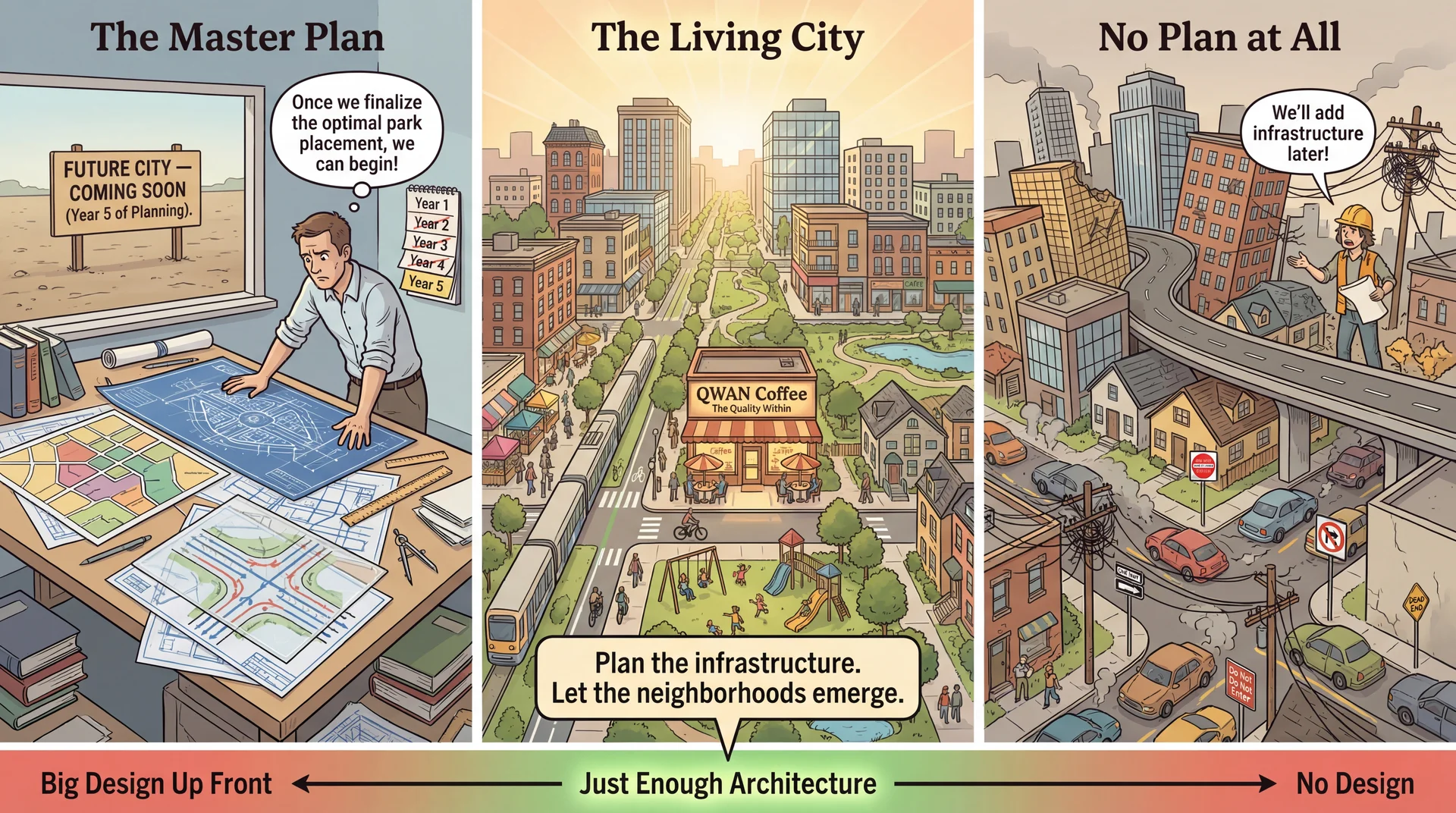
Plan the Infrastructure, Let the System Emerge The city planning metaphor:
Left (Master Plan): Beautiful blueprints, but nothing built. Years of planning, no city.Right (No Plan): Buildings thrown up wherever, roads to nowhere, infrastructure chaos.Center (Living City): Key infrastructure was planned (roads, utilities, zoning), but neighborhoods grew organically within those constraints. The key insight:
"Plan the infrastructure. Let the neighborhoods emerge."
In Chirp: we planned the component boundaries (Feed Service, Identity Service, Platform API) and the key contracts (Post, FeedResponse)
But we didn't plan every feature — direct messaging, hashtag trending, and community lists all emerged from use
Christopher Alexander connection:
Alexander was a real architect who influenced software patterns deeply
His book The Timeless Way of Building (1979) argues: the most livable spaces emerge through gradual, adaptive growth, not master plans
The same is true for software — we discover what the architecture should be by building and using the system
Easter egg for the curious:
"QWAN Coffee" = "Quality Without A Name" — Alexander's term for the ineffable quality that makes spaces feel alive
He couldn't quite define it, but you know it when you see it
If students ask: "It's a reference to Christopher Alexander — look him up!"
→ Transition: Let's see how a microblogging platform grows this way...
Piecemeal Growth: Features That Emerged
Chirp's first version could post messages and follow users. Features were added as real needs emerged:
Feature When it was added What prompted it Hashtags After users invented them organically Users were already tagging posts with #topic — the platform just made them clickable Direct messages After users asked for private communication A new MessageService was added behind the existing Identity boundary — no changes to Feed Service Content warnings After communities asked for sensitive content controls An optional field added to Post — existing clients ignore it, new clients display it Algorithmic feed toggle After users complained about missing posts A new ChronologicalStrategy implementation — no changes to FeedService itself
None of these were in the original design. But the architecture made each addition cheap because the right boundaries were in place from the start.
Key insight: Each new feature was contained within one component or added a new implementation of an existing interface.
Hashtags: contained in the Feed Service — no identity or platform changes needed
Direct messages: new service behind the existing Identity boundary — Feed Service unchanged
Content warnings: optional Post field — backward compatible, no component boundary changes
Algorithmic toggle: new RankingStrategy implementation — FeedService unchanged
This is piecemeal growth working correctly:
The architecture didn't predict these features
But the boundaries were drawn in the right places so each feature could be added cheaply
If identity and feed had been tangled together, direct messages would have required touching both
→ Transition: So how much do we decide upfront?
Just Enough Architecture
Decide what's hard to reverse ; defer what's easy to change ; design the system so deferred decisions stay cheap.
Decision Why it was decided early Cost of getting it wrong Centralized identity Every post, follow, and mention depends on it Moving to federated identity means rewriting every component that touches users Narrow API boundary between Feed and Platform Decouples feed evolution from storage — each evolves independently Every feed change would require a platform deployment RankingStrategy interface New algorithms = new class, not new architecture Adding an algorithm would require forking the entire feed pipeline Post as the stable data contract Every component reads and writes Posts Changing Post shape means touching every component simultaneously
Decision Why it was safe to defer Where it lives Which ranking algorithm to use by default Behind the RankingStrategy interface — swap without touching FeedService EngagementStrategy, ChronologicalStrategyHow posts are stored Behind the PostRepository interface — swap storage engine without touching Feed Service Can switch from Postgres to a document store without rippling Content warning display format Optional field in Post — clients that don't know about it just ignore it UI layer only
The "decide now" items are all about separation:
How components talk to each other (narrow API vs. shared database)
Where intelligence lives (Feed Service vs. Platform)
Getting these wrong means rewriting multiple components simultaneously
The "defer" items are contained within a single component:
They can change without rippling across boundaries
The RankingStrategy and PostRepository interfaces are exactly what make deferral safe
Chirp vs. Flock:
Chirp decided centralized identity early — and that decision is now very expensive to reverse
Flock decided federated identity early — and that decision is also very expensive to reverse
Neither is wrong; both are just foundational, and foundational decisions are the ones you have to get right upfront
→ Transition: Summary...
Looking Forward: Where These Ideas Go Next Concept from Today Where It Goes Quality Attributes (testability, changeability...)L19: Deep dive into architectural qualities — hexagonal architecture applied to CookYourBooks, tradeoffs between -ilitiesComponent Boundaries & APIs L20-21: What happens when boundaries cross networks? Distributed architecture, fallacies of distributed computing, serverlessData Coupling Decisions L20-21: Distributed data is even harder — consistency, latency, the CAP theoremArchitecture Communication (C4, ADRs)L22: Conway's Law — how team structure affects (and is affected by) architecture
The vocabulary you learned today — drivers, boundaries, coupling, expensive decisions — will be your lens for the rest of the course.
The arc ahead:
L19 (Architectural Qualities): We'll apply hexagonal architecture to CookYourBooks, seeing how ports and adapters create testable, changeable systems. Deep dive into how architectural choices affect the -ilities.L20 (Networks): When your components communicate over a network, everything gets harder. The Fallacies of Distributed Computing. Client-server architecture.L21 (Serverless): Infrastructure building blocks — databases, blob storage, queues. Serverless as an architectural style.L22 (Teams): Conway's Law — "Organizations design systems that mirror their communication structure." Architecture isn't just technical; it's social. The throughline: Today's question was "what boundaries should we draw?" The next lectures ask "what happens at those boundaries?" — first within a process, then across networks, then across teams.
Final thought: Next time you use a social platform, think about the architecture making it happen. The boundaries between identity, feed, and storage are deliberate choices — each made for a reason. Now you have the vocabulary to discuss why.
![XKCD cartoon with 3 frames.
Frame 1: [Cueball sits at a table, eating a meal.]
Cueball: Can you pass the salt?
Frame 2: [Cueball pauses, a bite of food on his fork, silently.]
Frame 3: [Cueball still has fork in mid-air.]
Cueball: I said-
Off-screen person: I know! I'm developing a system to pass you arbitrary condiments.
Cueball: It's been 20 minutes!
Off-screen person: It'll save time in the long run!](/cs3100-public-resources/img/lectures/web/l18_xkcd_the_general_problem.png)